
Can AI do strategy?
AI can perform substantial parts of strategic work. The harder question is which choices we should let it make. A strategy concentrates effort and leaves other possibilities behind. It may choose one audience, market or message over another. A machine can recommend those choices; the organisation still has to live with them.
A machine can optimise a choice you hate
Imagine perfect commercial data. The system identifies the most profitable route with extraordinary confidence.
Unfortunately, the route requires the company to stop investing in the product the founder cares about most. Or leave the market the team is proud to serve. Or abandon a way of working that half the organisation joined for.
The strategy may be economically excellent. Everybody may hate it. You can argue that the emotional consequences should simply be added to the data. Fine. Then the data needs to contain the politics, identity, history, morale, relationships and human consequences of the choice with enough fidelity to make them comparable.
We are not there. I am not sure that is a world I am excited to reach either.
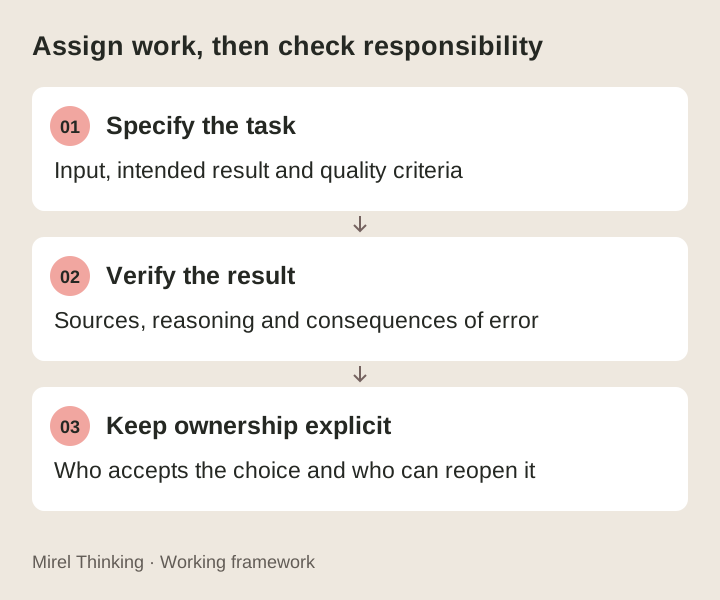
Which strategic tasks to give AI
Use four tests: can you define the task, describe a good result, verify the result and live with the consequences of an error? Research organisation, competitor comparison and first drafts can be good candidates when the sources are available and someone can check the reasoning.
Ambiguity changes the assignment. If the problem is unresolved, ask the model to surface contradictions and missing decisions before generating recommendations. Where verification is difficult, as in synthetic audience responses, treat the output as a hypothesis to investigate. Keep the consequential choice with someone who understands and owns it.
A task review should include the handover. Which accepted decisions must the next step retain? Who can reopen them? Persistent client context and a sequence that improves model outputs matter because a strong answer becomes less useful if the following task starts from incompatible assumptions.
Review alternatives deliberately if the recommendations start to sound interchangeable.
Test the boundary on your own work
The HBS research on the jagged technological frontier found that AI assistance helped on some consulting tasks and harmed performance on a task beyond its capabilities. That is a reason to evaluate tasks separately, not to assign every model a permanent list of strengths.
Liu and colleagues’ Lost in the Middle study found position-sensitive retrieval in the models and tasks they tested. A long context window therefore does not, by itself, establish that the right evidence was used.
Doshi and Hauser’s 2024 short-story experiment found that AI ideas could improve individual ratings while making stories collectively more similar. It studied creative writing, not agency strategy; it is a useful warning to test variety as well as fluency.
Choose a completed assignment with a known outcome. Give the system the inputs that existed at the time, record its errors and have a strategist review the decisions without seeing which route produced them. Use that local evidence to decide what responsibility to assign.
Humans still do three jobs in the process
The first is boring and practical. They fill in what the system does not know. Briefs are incomplete. Clients forget things. Important context lives in someone's head. A person has to add what is missing. The second is judgement.
At each stage, somebody needs to decide whether the work rings true. What should be added? What is weak? What should be removed? Is this good enough to become an input to the next decision?
The third is ownership. This one matters more than it sounds. A strategist who has seen the evidence, challenged the assumptions and made the choices can defend the strategy. They understand why the rejected options were rejected. They can explain the sacrifice. They can sell it to a client without reciting a summary document.
You cannot shortcut that experience by handing somebody a beautifully written final answer five minutes before the meeting.
In a general chat tool, the user often has to maintain that ownership and sequence themselves.
Better strategy is not enough
If a machine can one day produce a statistically better strategy than a human team, the question still does not disappear. The strategy has to enter an organisation. People have to believe it, explain it, use it and make decisions that remain consistent with it when the original deck is no longer open.
A recommendation that nobody owns has a limited half-life. This is one reason I am less interested in removing humans from strategic systems than in changing where humans spend their attention. Use machines to carry more of the labour. Let people spend more time on judgement, decisions, workshops, creative sparring and the client conversations where the sacrifice becomes real.
At the next project start, specify which decisions people will make, which work AI will prepare and how each output will be challenged. Make the ownership visible before a recommendation reaches the client.
Mirel’s workflow makes human review part of the sequence; the team still has to decide whether the work is ready to move on.