
Does AI replace strategists? It replaces some strategic labour.
There is an obvious question hanging over every conversation about AI and strategy. If AI gets good enough at strategic work, do agencies still need strategists?
Some strategic labour will be replaced. Agencies may need fewer people to produce the same volume of first-pass analysis and drafting, and some strategist roles may disappear. That is different from strategy disappearing or experienced judgement losing its value. The important question is which part of strategic work will continue to earn a premium.
Start with what strategists do
A strategist might spend a day reading research, interrogating a brief, looking at competitors, analysing data, talking to account management, developing hypotheses, building an audience profile, writing a positioning, discussing ideas with creatives and turning all of it into a presentation.
Some of these things require considerable judgement. Others require less. AI makes the distinction harder to ignore.
Give a good model a clearly defined analytical task and decent information and it can already do remarkably good work. Ask it to find patterns, compare competitors, structure research, identify contradictions or produce a first analysis.
Drafting is probably the most obvious candidate for substantial automation because so much of the preceding work is baked into it. To create a useful first draft, the system has already interpreted information, made a first analytical pass and structured what it found. Starting from a blank page becomes difficult to justify as the default.
The HBS and BCG field experiment found task-dependent effects of AI assistance in consulting. It provides evidence about performance on specified tasks, not a forecast of agency strategist employment.
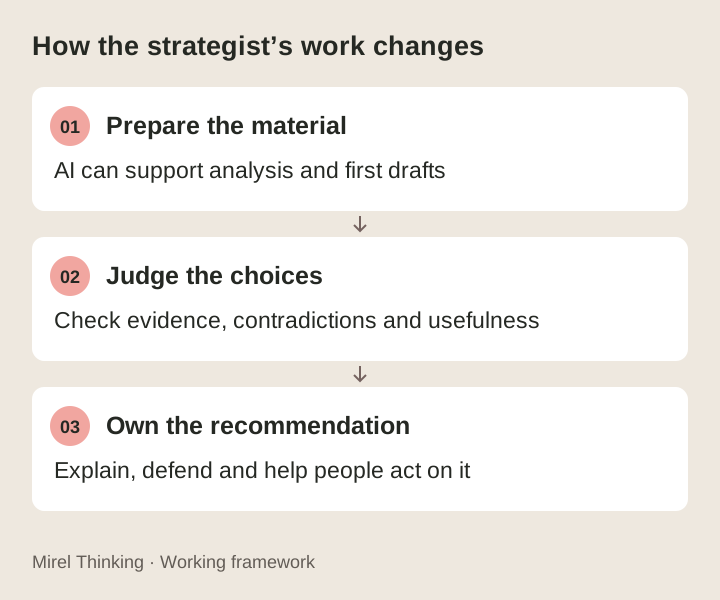
The work that follows the first draft
Suppose AI can produce a useful first pass from the available evidence. The strategist receives something to challenge instead of an empty PowerPoint page.
The team must still decide whether the diagnosis is right, whether two recommendations contradict each other and whether a plausible direction will produce interesting creative work. A client’s preferred answer may need challenging; another disagreement may be worth leaving alone. Those calls depend on the consequences as well as the quality of the text.
The practical allocation starts with which strategic tasks AI can support and how a person will verify them.
See how Mirel combines a strategic first pass with human judgement.
Competent production becomes cheaper
First-pass analysis, data interpretation and drafting will become faster. Producing a competent strategic answer will require less time and, in some cases, less experience. The people who mainly produced that first answer are exposed to real substitution.
The remaining premium sits in diagnosing the right problem, recognising a weak answer, making trade-offs, working with creatives and helping clients act on uncomfortable conclusions. Agencies may employ fewer strategists for the same volume of work while depending more heavily on the judgement of the ones who remain.
Can you explain the task, explain what a good result looks like and verify whether the result meets that standard? If so, AI can probably take on a substantial part of the work. Things become more interesting when an experienced strategist looks at a plausible answer and says, “It does not feel right.” That sounds unscientific. Sometimes it is. Experience often shows up before explanation.
You may have seen enough brands, categories, clients, ideas and failures for something to trigger before you can articulate why. Perhaps the positioning is differentiated and culturally dead. Perhaps the audience insight is true and useless. Perhaps the campaign logic works perfectly and still feels like something the competitor would do.
You can ask AI to challenge these things and teach it criteria. You should encode as much accumulated practice as possible. Some experienced judgement will remain difficult to specify completely.
Will agencies need fewer strategists?
I think that is plausible. It is a judgement about where the industry may go, not an established headcount forecast. Dividing today’s workload by an AI productivity multiplier leaves out demand that agencies currently cannot afford to serve: smaller accounts, neglected briefs and opportunities no one has time to investigate.
Cheaper groundwork may let more work receive strategy even if fewer people are needed for first-pass production. How much demand expands depends on what clients value and what agencies choose to sell. Specialist roles are exposed where most of their value sits in a bounded task that software can perform; deep expertise can still be essential when the task is unusual or the model is wrong.
For an agency lead, the useful response is to map tasks, supervision and client demand before changing headcount. Preserve the people needed to make decisions and develop others. Junior development becomes especially important when the first-draft work that once taught the craft is automated.
The August 2026 update to Stanford’s Canaries in the Coal Mine research reports weaker employment growth for young workers in highly AI-exposed US occupations. The authors describe the evidence as observational. It cannot establish how many agency strategists AI will replace.
Judgement as the differentiator when execution gets cheap
When producing another option becomes cheap, the agency has to make selection worth paying for. That means showing why the chosen route fits the evidence, what alternatives were rejected and what the choice allows the client to do. A polished document alone makes that value difficult to see.
In a pitch, parallel work can create the opposite result: creative territories gather momentum before the audience and problem are agreed. More production then creates more material to reconcile. Put a decision review before expensive development, and explain its value in terms the client can use.
This is where I would spend recovered capacity: difficult client conversations, creative collaboration and consequential decisions. Independent agencies competing with network infrastructure need to decide which of those capabilities distinguish them before copying the networks’ technology stack.
WPP’s 2024 Google Cloud announcement shows a network investing in AI-supported workflows. An investment announcement establishes intent and capability-building; it does not demonstrate fewer strategists or better strategic judgement.
The strategist becomes more human
If I were hiring a junior strategist for an AI-heavy agency, I would not be particularly interested in whether they are brilliant at prompting. Prompting can be learned and tools will change.
I would look for what I might have looked for in 2000: curiosity, an ability to understand systems, a genuine interest in people and the instinct to ask why something is happening instead of describing that it is.
As people become more senior, I would add the ability to work with humans. Strategists sit between clients, account management and creative teams. They need to inspire creatives without doing the creative work for them, challenge account management without becoming obstructive, push clients when it matters and occasionally accept something they disagree with. Winning every argument is not the same as being a good consultant.
There is a problem for juniors
Senior strategists developed judgement by doing much of the work AI can now accelerate. They read the research, built charts, wrote first drafts, made bad recommendations and watched experienced people tear them apart.
If AI takes over much of the first-pass work, agencies need to think about how juniors develop the experience required to judge its output later. Making someone do repetitive work because previous generations had to is not a compelling development programme. Letting AI do everything and expecting judgement to appear at 30 is not one either.
The job will need new ways of learning. I do not think we know exactly what those look like yet.
The role that remains has more value attached to knowing what to do with the first answer: consulting, decisions, collaboration and judgement. After all the new tools, the strategist of the future may be hired for many of the same qualities as the strategist of the past. There may simply be fewer people paid mainly for producing the first draft.
For strategists working with Mirel, the useful test is whether the time recovered improves the decisions and conversations they remain responsible for.