What is an AI strategy platform?
You can do surprisingly good strategic work with ChatGPT or Claude. Give either of them a well-defined problem, enough context and sensible instructions and you can get a very useful answer. So what makes something an AI strategy platform? The answer has relatively little to do with which model sits underneath it. The interesting question is what happens around the model.
A strategy platform connects strategic tasks, preserves relevant decisions between them and allows teams to develop the work over time.
A platform connects strategic decisions
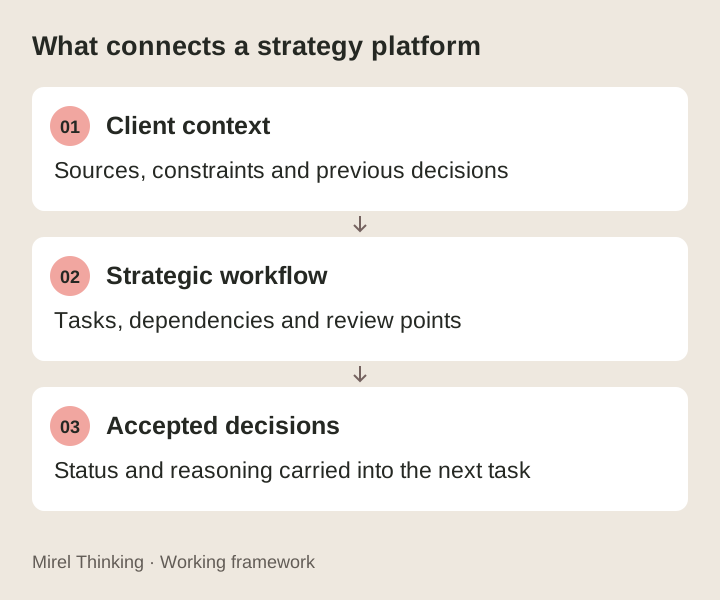
Imagine you are developing a campaign strategy. You start by understanding the brief, which may reveal that the problem is different from the one the client described. Then you look at the audience. What you learn there affects the choices you make later. You work on the positioning, which creates boundaries for what the campaign should say. Eventually you get to the campaign itself.
You could build an excellent prompt for every one of those tasks and still have a problem. Someone needs to remember what happened between them. The audience profile needs to inform the positioning. The positioning needs to inform the campaign strategy. A caveat discovered while interrogating the brief should not disappear because somebody opened a new conversation.
If another person takes over halfway through, they should not have to reconstruct the thinking from chat histories and PowerPoint files. That continuity is part of the work.
The workflow should resemble the job
A lot of AI software seems to start with what the technology can do. Strategy software should start with how strategists actually work, including the inconvenient realities.
Clients have opinions, feedback arrives halfway through and new information changes the work. Account management may start an assignment before a strategist takes over, while creatives need to understand decisions without reading everything that came before. A logically perfect workflow can still feel alien if it ignores these realities. The software needs to understand enough of agency mess to remain useful.
Relevant decisions need to survive
Saving everything is storage. A platform needs to preserve what later work depends on: agreed decisions, important qualifications and unresolved questions. It also needs to recognise when a later decision replaces an earlier one. Why AI needs persistent client context deals with the harder problem of institutional memory in detail.
Lost in the Middle (2023) found that information position affected retrieval in the tested models. It supports testing context use, rather than equating storage capacity with dependable recall.
Teams complicate things
Strategy is rarely produced by one person sitting alone with a machine. Someone might develop the audience understanding. Somebody else works on positioning. A third person picks up campaign strategy a month later.
The useful unit of memory is therefore the client and the team as well as the individual user. If useful work disappears into one person's chat history, the agency has not built knowledge. One person has. A strategy platform should make previous work available to the people who need it without forcing them to recreate the context every time.
A platform should connect a meaningful process
I am sceptical of calling something a strategy platform when it performs one narrow task. There are useful tools that generate propositions, analyse reviews, create personas or produce hundreds of variations. Some are excellent. I would call them tools.
A platform should accompany a meaningful part of the strategic process. It does not need to do everything, but the pieces it handles should connect. If an audience profile exists, later work should know about it. If a positioning has been agreed, campaign strategy should not casually invent another one. If a brief contains an unresolved contradiction, the system should not forget it because the user clicked into a different workflow.
Feedback belongs in that process too. Strategic work changes when somebody says the client will never buy the first answer, a direction is too safe, an assumption does not hold or the creative response exposes a weakness. The first output is often simply the first useful thing to disagree with.
Strategy needs provenance
If a platform produces strategic work from evidence, people need to know what informed it. Which source supports a statement? What did the system infer? What did a human decide? Which conclusion remains hypothetical?
This is partly governance and partly basic intellectual hygiene. A fluent recommendation can combine evidence, interpretation and guesswork so smoothly that the joins disappear. A useful platform should keep those statuses visible enough for a team to challenge the work and own the final decision.
If software performs one isolated strategic task, it may be an excellent tool. If it connects meaningful parts of the work, preserves state, supports teams and keeps the reasoning inspectable, I am comfortable calling it a strategy platform.
A working definition, with named examples
“AI strategy platform” is a working category in this article, not a certified industry classification. General assistants help with many tasks; research tools help find and organise sources; collaborative tools help teams work together. A strategy platform should connect those activities around decisions and their status.
WPP’s 2024 collaboration with Google Cloud describes AI capabilities within WPP Open. Publicis announced CoreAI in 2024 as part of a group-wide AI programme. These are examples of networks building infrastructure, not independent evidence of product quality.
An independent agency can compare named tools by the job they perform or consider building its own strategy agent. In either case, require a demonstration of a real handover: changed evidence, a revised decision and an output that reflects both. Mirel’s workflow is our answer to that requirement, and should be judged by the same standard.