
How to tell whether a strategy is actually good
Strategic recommendations can be persuasive for reasons that have little to do with strategic quality. The presenter is confident. The deck has a satisfying narrative. The answer sounds ambitious. Everyone is relieved that weeks of ambiguity have produced a direction.
None of these things makes the strategy good. I use a more practical set of questions.
Does it address the diagnosed problem?
The strategy should respond to the reason the current situation exists. If the diagnosis says people know the brand and distrust its claim, a strategy built around more awareness has missed the problem.
This sounds obvious and fails surprisingly often because the requested activity acquires momentum before the diagnosis is complete. A campaign was requested, so the team develops a campaign. The recommendation can be coherent while solving something adjacent.
The first test is simple: if the strategy works exactly as intended, why should the diagnosed problem become smaller?
Richard Rumelt’s The perils of bad strategy, adapted from Good Strategy Bad Strategy (2011), offers a useful test: diagnosis, guiding policy and coherent action. A recommendation should explain the obstacle, the approach and how the actions support one another.
Start with the hierarchy of objectives: it should connect the business result with the behaviour the work needs to influence.
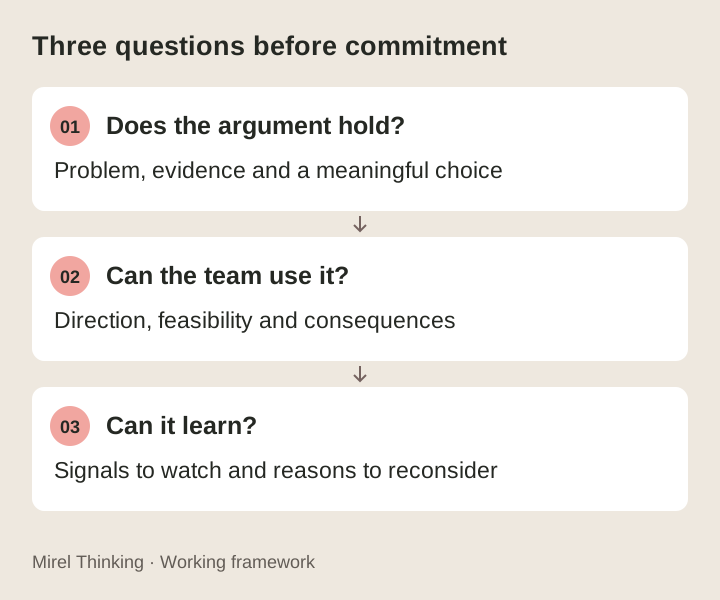
Does it make a meaningful choice?
A strategy should concentrate effort. It identifies a priority, commits to a route and accepts that other plausible options will receive less attention. If every audience remains central, every objective is protected and every message survives, the strategy has organised the wish list. It has not chosen. The choice should constrain action. People downstream need to know which opportunities fit, which attractive ideas pull away from the direction and what wins when objectives conflict.
A positioning choice should rule out plausible alternatives.
Is the reasoning supported and honest about assumptions?
Good strategy does not require complete evidence. It does require a defensible relationship between evidence, interpretation and recommendation.
Which claims are established? Which are inferred? Which assumptions carry the largest risk? What evidence would change the decision? A strategy becomes stronger when it makes uncertainty manageable. Hiding uncertainty inside confident prose makes review harder and failure less informative.
CEBMa’s evidence-based management approach combines critical thinking with the best available evidence. That makes the quality and applicability of the support part of the evaluation, alongside the attractiveness of the idea.
Distinguish facts, inferences and assumptions; give synthetic audience responses their own validation standard.
Can people act on it?
A recommendation may be intellectually interesting and operationally empty. “Become the most trusted voice in the category” sounds like a direction until somebody has to decide what the product, campaign or creative team should do differently on Monday.
Actionability does not mean reducing strategy to a task list. It means the choice has implications. It changes the creative brief, the allocation of resources, the sequence of activity or the standards used to select work. The people downstream should be able to act without reinventing the strategic decision.
Check that campaign and creative strategy give the next team usable decisions.
Is it feasible enough to deserve commitment?
Strategy can be ambitious. It still operates inside capabilities, budgets, brand credibility, organisational politics and time.
A direction that requires the client to become a different company before it can work may be an interesting provocation and a poor recommendation. Feasibility should not excuse timid thinking. It should expose the conditions the strategy needs and whether the organisation is willing to create them.
Sometimes the most important strategic conclusion is that communication cannot solve the diagnosed problem. That can be difficult to sell and remains better than confidently recommending work with no plausible mechanism.
The test also applies to strategic work prepared with AI; fluency should not change the standard.
Does it create useful advantage or memory?
A good strategy should improve the brand's position. This may come from a differentiated offer, a more distinctive way of being remembered, a better fit with a buying situation, greater coherence or a capability competitors will struggle to reproduce.
The advantage does not need to be permanent or exclusive. Very little is. It needs to be useful enough to guide investment and credible enough to survive contact with the market.
Jenni Romaniuk’s category entry point work directs attention to the situations and cues that bring brands to mind. It gives a concrete question for an otherwise vague ambition to become more relevant: in which buying situation should the brand be recalled?
Test the intended memory against the situations in which people buy.
Can it learn from reality?
Which outcomes would strengthen confidence in the strategy? Which would suggest the diagnosis or mechanism was wrong? Who will notice, and what can change? A strategy that explains every outcome after the fact cannot learn. Reality-testing needs to be designed before the results arrive.
Results should update our confidence in the reasoning, but they do not automatically reveal the quality of the original decision. A good strategy can fail because execution was weak, a competitor responded or the world changed. A bad strategy can get lucky in a booming market. “It worked” and “it failed” are evidence to examine, not retrospective verdicts on strategic quality.
I would not turn these questions into a scorecard that pretends judgement has disappeared. Their purpose is to make the judgement inspectable. A good strategy addresses the diagnosed problem, makes a choice, has an honest evidential basis, constrains action, can be implemented and creates a useful way to compete or be remembered. It should also remain capable of learning that it was wrong.
When evidence changes, decide which part of the process to revisit and document why.
The same standard should be applied to Mirel’s work for strategists before accepting a recommendation.