
Why pitches consume strategy capacity
Agency pitches have an unusual ability to consume every available senior strategist at exactly the wrong moment. Part of the reason is obvious. The deadline is fixed and the work matters. The other part sits in the strange economics of the agency business.
You often pitch where you know the least
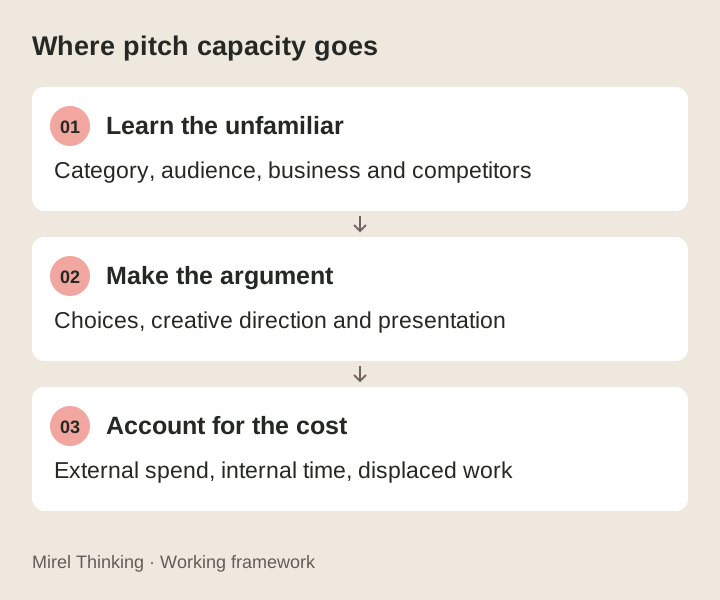
Agencies frequently avoid direct category conflicts. That means a new-business opportunity can arrive from an industry where the agency has little current client experience. The strategist now has to learn the category, understand the competitors, get a feel for the customer and work out the commercial dynamics. That is the normal strategic groundwork.
Then the pitch problem starts. So the team is doing the foundational work and the actual assignment at the same time, under a deadline, without the accumulated client knowledge that makes retained work faster.
The IPA and ISBA’s Good Pitch guidance calls for clear requirements and stages so agencies can judge whether to participate and how much to invest. Ask for that clarity before allocating a team.
The strategist often has a second job
In many agencies, strategy also shapes the pitch story. Somebody needs to decide what the presentation is really saying, how the argument builds, what the creative idea needs around it and which material deserves to survive. That can be a substantial job in its own right. Now the strategist is doing category strategy and presentation architecture together. It is easy to see why pitches create sudden peaks.
The uncomfortable bit: the strategies often converge
I have sat on the client side of the pitch table. You sometimes watch five agencies present five variations of broadly the same category insight and strategic direction. The creative executions can be wildly different. The strategic chapters are often less so. That does not mean the groundwork was wasted.
The creative teams still needed guardrails. Without them the agencies might have produced five different executions solving five different problems. The question is whether all of the strategic work needed to become a chapter in the pitch deck. Often it does not.
The BetterBriefs research finds substantial disagreement about whether briefs give clear direction. A pitch team should expose unresolved choices early rather than building the presentation around conflicting interpretations.
Do the strategy. Show what the client needs
A pitch presentation does not need to prove that every framework was completed. The strategic work should set the stage for the creative answer. Sometimes the client needs to see more because the diagnosis itself is surprising or the strategic choice needs selling. Sometimes the strategy can live in a few sharp slides that make the creative idea feel like the logical response.
There is no prize for a chapter called “Our Strategy” if it mostly repeats what the previous agency said forty minutes earlier.
Reducing pitch cost starts with the real cost
Agencies often multiply internal hours by internal rates and describe the resulting number as the cost of pitching. That is useful for understanding resource consumption. It is not always cash leaving the business. Ask what the pitch displaced. Did the agency bill less work because people were pitching? Did it bring in freelancers? Did it pay for production, travel or external theatre?
I would cut unnecessary freelance and production spend before I cut rehearsal. I would also spend money on presenting in person when the opportunity justifies it. A cheaper pitch that feels cheap is not the objective. The point is to stop spending senior strategic capacity on work that exists mainly because “this is how we pitch”.
For a cash-cost illustration, RedSofa’s Berlin 2025 report lists freelance senior strategists at €400–€600 a day. Five external days would therefore cost €2,000–€3,000 in fees before any applicable extras. Five days is an assumption for this example, not an observed average pitch duration.
Agency leads considering Mirel should test it on the preparation and decisions that consume time in their own pitches.