
The economics of strategic work in creative agencies
Strategy is one of the stranger resources on an agency P&L. It can look extremely expensive and extremely profitable at the same time. That is why managing it through billability alone produces some odd decisions.
Why strategy margins are getting squeezed
A lower fee does not automatically create a smaller strategic problem. The agency may still need to diagnose the situation, challenge the brief and give creative work a direction. When those hours disappear from the scope, the work can migrate into account management, creative leadership or a senior strategist’s evening.
Production income and unpaid extra hours can conceal that transfer for a while. Neither tells you whether the assignment is profitable on sustainable terms. Record the work actually required and compare it with the fee recovered. Then decide whether to reduce scope, improve delivery or renegotiate.
Promethean’s 2026 agency survey reports an average after-tax net margin of 13% for 2025 among 119 mainly North American digital agencies. That is context, not a German strategy-team target: net margin includes the whole business, whereas the example below measures contribution before shared overhead.
A worked example in euros
Start with a salary that has a source. RedSofa’s Berlin State of Pay 2025 gives €60,000–€85,000 a year for a senior strategist and €400–€600 a day for freelance senior strategy (printed page 65). These are recruiter and survey ranges, not a guaranteed quote for your agency.
For an illustrative annual model prepared in October 2026, take a €75,000 salary, add an assumed 30% for employer costs and benefits, and allow 200 working days of eight hours. That produces €97,500 in annual employment cost and 1,600 available hours. The 30% and 200 days are modelling assumptions, not RedSofa findings or payroll advice; replace them with your own figures.
At an assumed realised selling rate of €120 an hour and 60% billable utilisation, 960 billed hours produce €115,200 in revenue. Subtracting €97,500 leaves €17,700 before shared overhead, software and other costs. At 75% utilisation, 1,200 billed hours produce €144,000 and leave €46,500 on the same basis. The employment-cost break-even is 812.5 billed hours, or about 51% utilisation; it is not the agency’s profit break-even.
The rate here is what the agency actually recovers. A rate card that says €120 while fixed fees and overservicing yield €85 is a different business. Change the inputs before using this calculation to approve a hire or a price. Increasing utilisation by displacing training or quality review can improve this year’s arithmetic while damaging next year’s work.
Billability is only the first lens
Bad agency management stops here. How many hours did the strategist bill? What was the recovery rate? How utilised were they? Those questions matter. Agencies need revenue. They do not capture the whole value of strategy. Good strategy improves the economics of the work around it. A clear brief reduces wasted creative exploration.
A useful client challenge can stop a team spending weeks solving the wrong problem. A strategist can keep a client focused on the more profitable route instead of the attractive distraction. Strong strategic work can improve client satisfaction and make an agency relationship harder to replace. Those effects rarely show up on the strategy line of a timesheet. They still affect the P&L.
Poor strategy creates work elsewhere
The inverse is easier to see. A weak brief creates more creative routes, more internal discussion and more rounds with the client. An unclear positioning forces every campaign to reinterpret the brand. A strategist who arrives late may have to rewrite the logic around creative work that is already in motion.
The agency can remain very busy while becoming less profitable. That is why judging strategy purely by its own hours misses part of the economic mechanism.
The BetterBriefs global research documents a large gap between clients’ and agencies’ views of brief quality. It does not put a cost on your agency’s rework. Track that locally before claiming savings from better briefing.
The opportunity cost of senior judgement
There is another cost that agencies rarely discuss explicitly. Where are you spending the best strategist's judgement? Agencies usually allocate people to accounts for good reasons. Continuity matters. Client knowledge matters. Relationships matter. The result is that an exceptional strategist may perform routine work simply because they are “the strategist on the account”.
That creates an opportunity cost. The same person cannot spend that time on a difficult pitch, a broken brief or the moment where a junior actually needs senior judgement. Historically, continuity made this difficult to avoid because so much knowledge lived in the individual. Better systems can change some of that constraint. Not all of it. The client relationship still belongs to people.
Record unbillable senior interventions so their cost does not vanish into the account allocation.
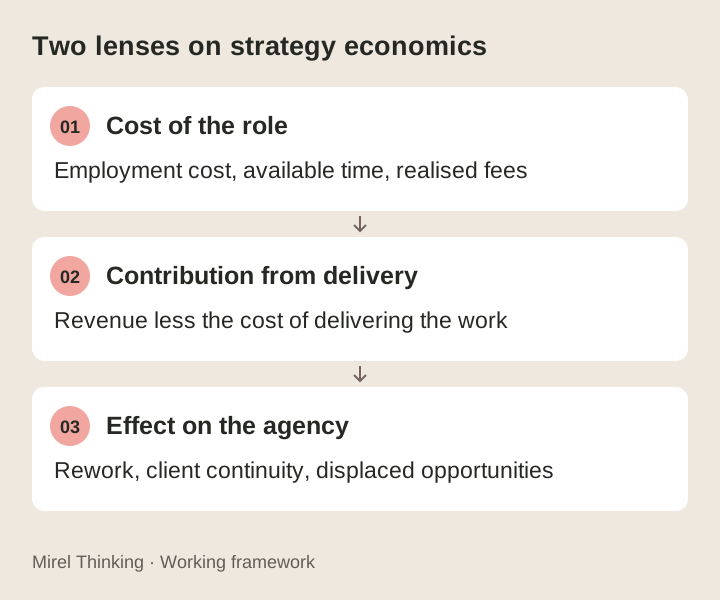
Strategy needs two economic lenses
The first lens asks whether the strategy resource is financially healthy in its own right. Cost, revenue, utilisation and pricing all belong there. The second asks what strategic quality does to the rest of the agency. Does it reduce rework? Improve creative development? Strengthen client relationships? Increase pitch quality?
Make less experienced teams more capable? Prevent senior people elsewhere from spending time fixing avoidable problems? The useful management question is not whether strategists are expensive. Of course they are. The question is whether the agency is spending that expensive judgement where it creates enough leverage to justify the cost.
Use Mirel’s current pricing as one input to a delivery-cost model, alongside the review and integration time your team needs.