
How many strategists does an agency need?
There is no useful answer to the question “How many strategists should a 50-person agency have?” Three might be plenty. Three might be nowhere near enough. The number of employees tells you remarkably little about the amount of strategy work an agency needs to do. These two 50-person agencies are illustrative contrasts, not measured cases or staffing benchmarks.
A 50-person agency with long-standing retained clients can be strategically quite calm. The broad direction is set. The work is mostly campaigns. Strategy may mean an annual planning session, a few creative springboards and the occasional difficult brief.
Another 50-person agency may live on projects and pitches. Every few weeks somebody has to learn a new category, understand a new audience, work out what the actual problem is and create the strategic foundations from scratch. Same headcount. Completely different demand.
The symptoms appear before the maths
You normally know when there is not enough strategy long before somebody builds a capacity model. The existing strategists are permanently overworked. Account people complain that they cannot get a strategist because the strategist is on another account or a pitch. Smaller clients start to feel like second-class citizens. Their teams have to beg for strategy time, or they get none at all.
Then the allocation spreadsheets become slightly absurd. A strategist is assigned at five per cent to an account, which looks precise in a resourcing tool and means almost nothing in practice. Freelance bills climb.
Strategists rotate through smaller accounts because whoever happens to have a free afternoon gets the job. That creates a different problem. Each strategist brings a slightly different view, so the client receives less continuity precisely because the agency is trying to create more coverage. Those are capacity symptoms. They are more useful than a universal ratio.
Promethean’s 2026 research surveys mainly North American digital agencies. Its sample is useful context for agency economics, but cannot establish a strategist-to-headcount ratio for a Berlin creative agency. Build the staffing case from your actual work.
Assess the work and its concurrency
The main question is what clients ask the strategy function to do. Long-term retained clients often carry a lot of accumulated strategic infrastructure. The agency knows the category. It knows the client. The positioning exists. Previous decisions are understood. New work starts from somewhere. Project clients are different. Pitches are different again.
A pitch can require the agency to understand an unfamiliar market, competitors, audience, category conventions and the client's business before the real pitch problem has even begun. That creates much heavier strategic demand than maintaining a familiar account. Concurrency matters too. One strategist might touch 24 different clients or pitches over a year and rarely work on more than two at once. Another might have four permanent accounts that all need attention every week. The second person can easily be more stretched.
IPA and ISBA pitch guidance recommends assessing the requirements and process before committing effort. Treat a pitch as a separate demand on the portfolio, rather than assuming it fits into unused account time.
Strategy is expensive and valuable at the same time
Agencies sometimes treat strategy as expensive overhead because senior strategists tend to be well paid and their utilisation never looks perfectly neat. The same strategist can also be one of the most economically productive people in the building.
RedSofa’s Berlin State of Pay 2025 lists senior strategist salaries of €60,000–€85,000 a year (printed page 65). Salary is only one component of employer cost. Compare the full cost with realised fees, client continuity and the work that a good decision saves elsewhere.
Good strategy gives creatives guardrails. That reduces wasted exploration. It helps the client avoid spending money on things that do not support the objective. It makes it easier to say no when the attractive new idea is strategically wrong. None of that fits neatly into “strategy hours billed”.
When should you hire another strategist?
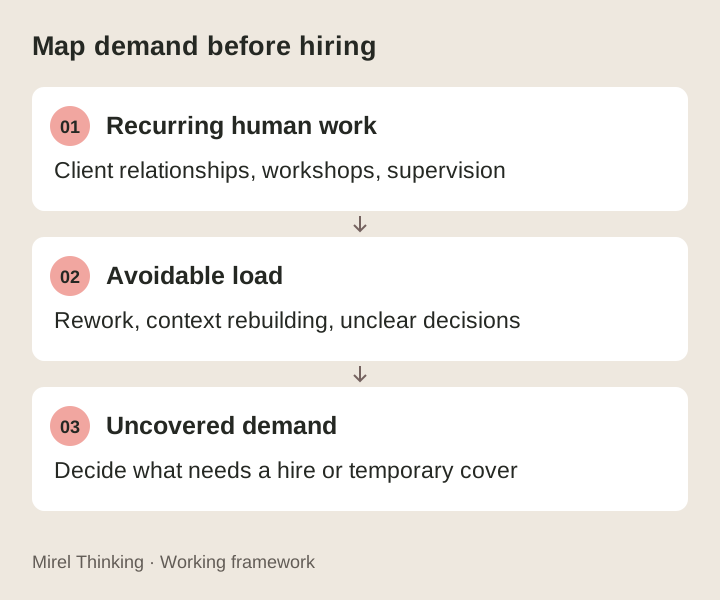
Hire when there is recurring, valuable work that requires another person: client relationships, workshops, creative collaboration, supervision or strategic work that the existing team cannot cover. The person is part of what the client is buying. Software can prepare a workshop; it cannot become the adviser the client trusts.
Before approving the role, separate that demand from work created by the agency’s own process. Rebuilding context, reopening decisions after creative development starts and reviewing endless first drafts all consume capacity. A hire may still be necessary after you fix those things. You will have a better job description and a more credible workload for them.
Review the portfolio over several planning cycles. An individual account may be quiet while total demand remains steady. Use concurrent account demand to assess the permanent role and consider temporary cover for peaks. A permanent shortage and an occasional difficult month require different responses.
What happens when account and creative cover strategy
Account people and creatives can be excellent strategic thinkers. The question is whether their contribution improves the work or disguises a staffing shortage. An account director understands the client’s politics and history; a creative director can spot a human tension that a strategist missed. Both bring something valuable.
They also have other responsibilities. A day spent by a creative director repairing a proposition is unavailable for leading creative work. Account-led strategy may lean towards the client’s existing logic; creative-led strategy may organise the argument around an idea already taking shape. Neither tendency is inevitable, but independent challenge becomes harder when one person owns both jobs.
Record that time against the problem it solves. Removing strategy from the allocation does not remove its cost. Agree who makes the strategic decision, who challenges it and which other work must move to make room.
The better question
Instead of asking how many strategists an agency of your size should employ, ask what kind of strategic workload the agency has created. How much of the work starts from first principles? How much pitch activity is there? How many assignments are live at the same time? How much senior client presence is expected from strategists?
How much time do senior people spend teaching and fixing junior work? How much strategic work is currently being done by account and creative because the strategy team cannot reach it? How much strategy never happens at all because the smaller account cannot justify the allocation? Once you can answer those questions, headcount becomes easier to discuss.
A useful strategy function is not the one with the correct ratio of strategists to employees. It is the one that can put good strategic thinking against the work that needs it without making everybody fight for access to the same two people.
Mirel for agency leads is intended to help distribute strategic work; evaluate it against the workload you have just mapped.