
Part II
Why strategy margins are getting squeezed in agencies
There has been something wrong with the agency business model for a long time.
For years, it was relatively easy to live with. Clients pushed rates down. Agencies found efficiencies somewhere else. A few more hours went into the job than were allocated. Production generated income. Teams stretched when they had to. Nobody particularly enjoyed it, but the machine kept moving.
Many of those escape routes are disappearing at the same time.
Agencies are being paid less for the work they produce
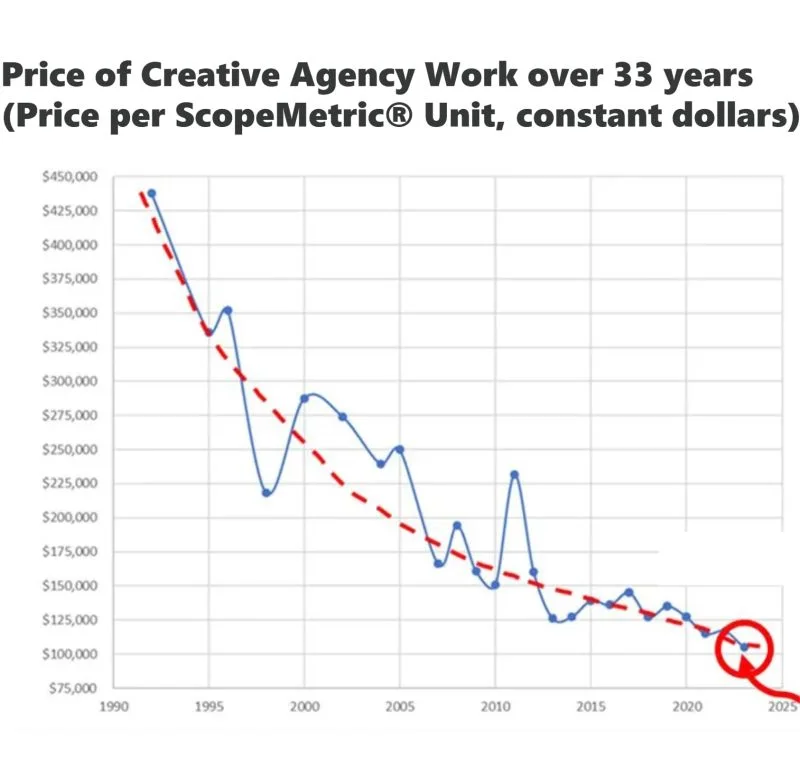
Farmer & Company has tracked the relationship between agency fees and agency workload for decades. Its ScopeMetric methodology normalises different agency deliverables into comparable units of work.
Farmer & Company client data shows the inflation-adjusted price paid for one ScopeMetric Unit falling from about $435,000 to $110,000 across 33 years. Michael Farmer describes that as a 75 percent decline in real prices.
The pattern is brutal. Agencies are producing more for less, and they have been doing so for decades.
The cost base has moved in the other direction
People have become more expensive. That matters enormously in a business where people remain the principal cost. A senior strategist does not become cheaper because a procurement team negotiates another five percent off the agency fee. Neither does an account director or a creative team.
Agencies also benefited from hidden capacity. Late nights, long pitch weeks and excessive overtime contributed hours that were never fully reflected in the cost of servicing clients. Changing expectations around work, together with tighter regulation in some markets, make that capacity harder to rely on. This is good for employees and economically significant for agencies.
Other cushions are disappearing
Production margins once helped support agency economics. Clients have since moved capabilities in-house, specialist production companies compete directly, procurement has become more sophisticated and technology has reduced the cost of some forms of execution.
Then add overservicing. A supposedly small request becomes three hours. Three hours becomes a day. The agency wants to keep the client happy, so the work gets done and the hours do not always get billed.
Strategy is particularly exposed
Clients still need someone to understand the problem, interrogate the brief, decide what matters, understand the audience, find the opportunity and give creatives a useful direction.
Yet strategy is often treated economically as overhead. When budgets tighten, strategy hours disappear from the spreadsheet while the strategic work moves elsewhere. A strategist absorbs it. An account person does it. A creative director gets involved. A senior person spends Sunday fixing it before Monday's meeting.
The spreadsheet looks better. The underlying economics do not.
Efficiency now matters differently
Agency efficiency used to be useful. Increasingly, it is structural. When agencies receive less money for more work while their cost base rises, the difference ends up in margin, quality or people's evenings.
Thirty years of pricing pressure will not reverse because agencies ask politely. The practical question is whether agencies can change how strategic work gets done while protecting the quality of the decisions. That question is becoming unavoidable.