
How to interrogate an incoming client brief
By incoming client brief, I mean the document arriving from the client or account team: the input strategy needs to interrogate before it becomes a brief for creatives. When I receive one, I instinctively look for two things. Where does it contradict itself? And is it really a brief, or is it an unrealistic wish list wearing a sensible template?
This is not cynicism. A brief is often the point where months of business pressure, internal politics, research, ambition and anxiety are compressed into a few pages. Compression creates problems. The task of the strategist is to find them before the creative team spends time solving the wrong thing.
When the brief makes no sense
I once received a coffee-brand brief that amounted to “we need a new campaign”, surrounded by business information, brand history, past work and stakeholder ambitions. Information was plentiful. A clear problem was missing. Starting to generate ideas would have made the agency busy before it had agreed what needed solving.
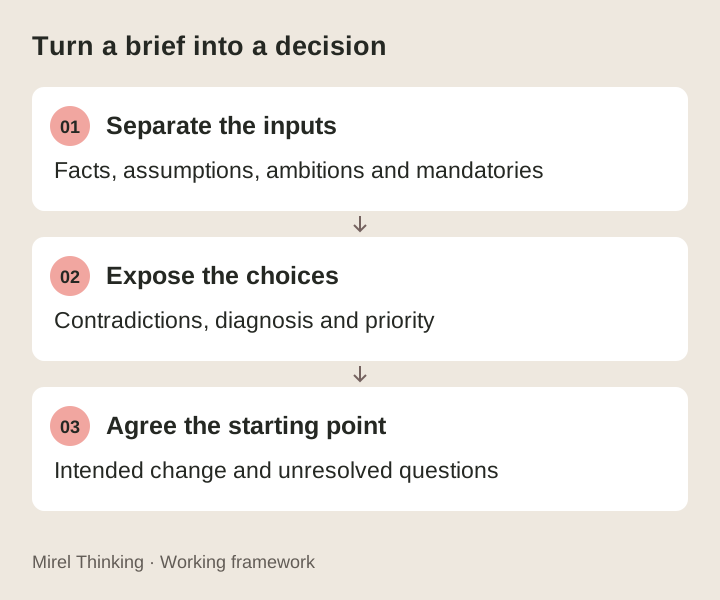
Take the document apart first. Separate facts, business objectives, communication objectives, assumptions, mandatories and proposed solutions. Then ask what needs to change in the real world: consideration, trial, repeat buying or something else. Each answer implies different work.
Show the contradictions back to the client as choices with consequences. If stakeholders cannot agree a priority, keep that disagreement visible and ask whether the challenge can be reframed. Do not quietly remove the conflict in a polished rewrite and let creative discover it later.
Contradictions are useful evidence
A brief might ask for premium perceptions and mass accessibility, immediate sales and long-term brand building, younger customers without alienating the existing base, or a bold departure that stays completely consistent with everything the brand has done before. Each request can sound reasonable on its own. Together they may be impossible.
The contradiction is rarely something to tidy away. It tells you where a decision has not been made. Sometimes the client has not noticed. Sometimes everybody has noticed and nobody wants to be the person who says it. Either way, it deserves attention.
I would rather surface it plainly: these objectives pull in different directions, so which one wins when they conflict? A brief becomes useful when it gives the work a priority.
The BetterBriefs global report describes a sharp mismatch between marketers’ confidence in their briefs and agencies’ assessment. Treat agreement on the problem as work to do together, rather than assuming the document has already achieved it.
A diagnosis gives the brief a centre
Lots of information does not create a strategic problem. A brief can contain market trends, audience charts, competitor examples, brand history and six objectives while leaving the reader with no clear account of what is happening.
I look for a diagnosis. What has changed? Why is the business not getting the result it wants? What is preventing the audience from behaving differently? Which part of that can communication plausibly influence? The diagnosis does not need to appear as a perfect logical chain. Real situations are rarely that tidy. It does need to give a reason for the choices that follow. No diagnosis, no strategy.
Without it, the brief tends to become a request for activity. Make a campaign. Reach younger people. Increase awareness. Be more famous. Those may be desired outcomes, but they do not yet tell a creative team what problem it is solving.
Richard Rumelt’s 2011 explanation of good strategy connects a diagnosis to a guiding policy and coordinated action. Applied to briefing, it asks whether the requested activity follows from an account of the problem.
Connect the diagnosis to business, behavioural and communication objectives so the client can see which change the brief is asking the work to produce.
Ask what would change the diagnosis
Interrogation should identify more than weak assumptions. It should show which unanswered questions could materially change the decision. What evidence would make us abandon this diagnosis? Which uncertainty affects the choice of audience, objective or message? What can remain unresolved because every credible answer leads to the same action?
This prevents research from becoming a general request for more information. It focuses attention on the evidence that could make the strategy move.
The Centre for Evidence-Based Management recommends critically evaluating the evidence behind a decision. For a brief, separate what was observed from what the client believes it means before deciding what to investigate.
The wish-list test
A useful brief accepts limits. It says what matters most, what the brand can credibly do and what this assignment can realistically achieve. A wish list does the opposite. It keeps every stakeholder's ambition and asks the work to satisfy all of them.
One quick test is to ask what can be removed. If every objective is essential, every audience is a priority and every message must appear, nobody has really briefed anything. They have transferred the decision to the people downstream.
That creates predictable creative work. The team either tries to include everything, producing something crowded and bland, or quietly chooses a priority itself. The latter can lead to good work, but the strategic decision then happens by accident and may be reversed as soon as the client sees it.
Do not reward the brief for existing
Less experienced people often take a brief at face value. They start collecting references, filling frameworks and generating directions without adding much or asking an uncomfortable question. The document feels official, so its assumptions acquire authority.
An experienced strategist knows that the brief is an input. It may be excellent. It may also contain outdated beliefs, political compromises or language that means different things to different people. Interrogating it means testing those assumptions while respecting the people who wrote it.
That last part matters. Consultants do not win trust by treating every imperfect brief as evidence that the client is foolish. Some wrong opinions are central to the work and need to be challenged. Others are not worth a fight. Judgement includes knowing the difference.
That agreement matters most when strategy starts changing after creative work begins.
What a useful interrogation produces
By the end, I want a clearer account of the problem, the priority, the audience, the role of communication and the constraints the work must respect. I also want unresolved questions to remain visible. False certainty at this stage only becomes expensive certainty later.
The output should be a clear diagnosis, a genuine priority, explicit assumptions and decision-critical questions. Agree those with the client before turning them into a brief that gives creatives useful direction.
Mirel’s account-management workflow gives the team a way to work through the incoming brief before handing it on. See how Mirel structures brief interrogation.